Key Points
- What it was: a shared loyalty programme that pooled VIP points and status across a family of separately branded online casinos into one account.
- 2026 status: the network closed to new New Zealand registrations at the end of April 2026; this article is a reference, not a sign-up guide.
- Two currencies: VIP points were redeemable for bonus credit (historically 100 points = 1 credit, 1,000-point minimum); status points set your tier (1 per 50 VIP points).
- Six tiers: Green, Bronze, Silver, Gold, Platinum and Diamond, reviewed each calendar month.
- Odds unchanged: loyalty status never altered a game’s return-to-player or house edge.
- The law: New Zealand’s Online Casino Gambling Act 2026 (in force 1 May 2026, DIA-regulated, 15-licence cap) limits lawful online casino services to licensed operators from 1 December 2026.
What is the Casino Rewards loyalty programme?
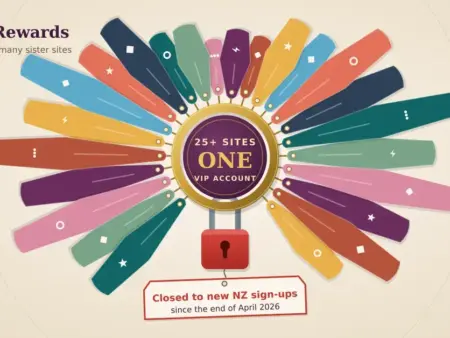
The Casino Rewards loyalty programme is a single, pooled rewards scheme that sat behind a family of online casino brands rather than a casino in its own right. Instead of each brand running an isolated points system, the operator connected them to one central loyalty database. A player registered on several brands using the same details would see their wagering feed into one combined balance of VIP points and one status level, no matter which brand the bets were placed on.That pooling was the defining feature. On a standalone casino, switching sites means starting a loyalty scheme from zero. Within this network, a Kiwi who played a little on Zodiac Casino and a little on Grand Mondial Casino accumulated points and status in the same place. The programme marked 25 years in October 2025, making it one of the longer-running loyalty frameworks in the online casino industry.It is worth separating two things people often blur together. The loyalty programme is the long-term points-and-tier scheme described here. The welcome offers and deposit bonuses that individual brands advertised are a different thing with their own rules, covered further down.Can New Zealanders still join and earn Casino Rewards loyalty points in 2026?
No — the Casino Rewards network closed to new New Zealand registrations at the end of April 2026, so Kiwis can no longer open fresh accounts to start earning loyalty points. This change lines up with a much larger shift in New Zealand law, so the closure is best understood as part of the new regulatory picture rather than a one-off business decision.Because the programme is now effectively of historical and informational interest to New Zealand readers, this article explains how it worked rather than how to join it. If you are researching current options, the safest approach is to wait for operators licensed under the new domestic regime and to verify any licence claim independently before trusting a site.What the Online Casino Gambling Act 2026 changed
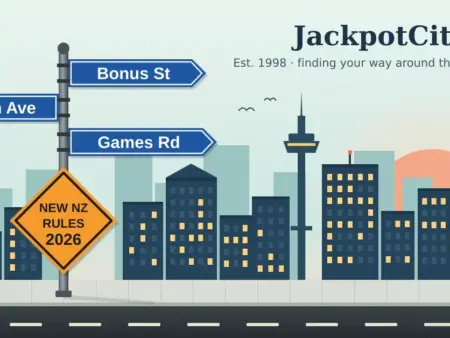
New Zealand’s Online Casino Gambling Act 2026 replaced the long-standing grey area with a licensed domestic framework, and its dates matter. The Act received Royal Assent on 27 April 2026 and came into force on 1 May 2026, with the Department of Internal Affairs (DIA) as the regulator. From that date, new offshore entrants were barred from offering online casino services to New Zealand residents.The regime is capped at 15 licences, awarded through a competitive process, and it applies extraterritorially — meaning it reaches operators based outside New Zealand that target Kiwi players. A transition period lets existing offshore operators continue serving New Zealand customers only until 1 December 2026; after that, only a DIA licence holder may lawfully offer online casino services here. Crucially for a site like this one, advertising unlicensed offshore casinos to New Zealanders has been prohibited since 1 May 2026, which is why ranked bonus lists and sign-up links are no longer published. For context on the wider market, our guide to the online casino landscape in New Zealand covers how the rules apply more generally.How the six-tier VIP loyalty system worked
The programme used six status tiers that players climbed by wagering real money across any connected brand. In ascending order these were Green, Bronze, Silver, Gold, Platinum and Diamond, with Green being the entry level assigned to new registrants. Each step up unlocked incrementally better treatment — things like dedicated promotions, birthday gifts, faster support and, at the top, a personal VIP host.Two separate currencies sat underneath the tiers, and confusing them was a common error. VIP points were the spendable currency you could convert into bonus credits. Status points were the measure used to decide which tier you belonged to. They were linked: status points were earned at a rate of one for every 50 VIP points accumulated, so heavier play pushed both your redeemable balance and your tier upward at the same time.VIP Loyalty Tiers
| Status tier | Status points to reach (as historically published) | Typical benefit focus |
|---|---|---|
| Green | Entry level on registration | Standard promotions and basic point earning |
| Bronze | 1 | Birthday bonus and entry-level perks |
| Silver | 6 | Higher support priority and extra promotions |
| Gold | 81 | Personal VIP contact and higher-value draws |
| Platinum | 201 | Raised limits and enhanced promotional matches |
| Diamond | 401 | Top match rates and tailored lifestyle rewards |
How status points were earned and counted
Status points accrued automatically from wagering, with the 50-VIP-points-to-1-status-point ratio determining how quickly you moved up. The thresholds in the table above are the figures the network historically published; operators can and do adjust such numbers over time, so they are best treated as an illustration of how the ladder was shaped rather than a guarantee. The key structural point is that the gaps widened sharply at the top — reaching Diamond required many times the activity of reaching Bronze.How often loyalty status was reviewed
Status was assessed on a calendar-month basis. Once a player reached a given tier, that level was held for the remainder of the current month and the whole of the following month, which gave a buffer rather than an instant demotion after a quiet week. Each tier also had a lower “maintain” threshold that was easier to meet than the “reach” threshold, so holding a level took less activity than first achieving it. Redeemable VIP points generally remained available while an account stayed active.How were Casino Rewards points redeemed for credits?
VIP points were converted into bonus credits at a published rate, and there was a minimum before redemption was possible. The historically used rate was 100 VIP points for 1 unit of currency in bonus credit, with a minimum balance of 1,000 VIP points before any redemption could be made. In practical terms that meant loyalty points translated into modest, steadily accruing bonus credit rather than large instant payouts, and the value built up gradually over many sessions.Redeemed credits were bonus funds, not cash, so they were subject to the same kinds of wagering conditions as other promotional credit before anything could be withdrawn. That distinction — points become bonus credit, bonus credit must be wagered — is where a lot of players misjudged the real cash value of a loyalty balance.Does casino loyalty improve your odds of winning?
No — loyalty status does not change the mathematics of any game. VIP tiers, points and perks are a marketing and retention layer sitting on top of the games; they do not alter a slot’s return-to-player percentage, a roulette wheel’s probabilities or the house edge on any table game. A Diamond-tier account and a brand-new Green account face identical odds on the same game.What loyalty schemes genuinely provide is a partial rebate on activity: the more you wager, the more points and perks you earn back. That is a cost-of-play reduction, not an edge. It is important to be clear about this because loyalty programmes are sometimes presented as if long-term members are “due” better results, which is not how randomised games work. The only reliable effect of more play is more money staked.The Time of Your Life sweepstakes explained
The Time of Your Life sweepstakes was the network’s headline loyalty perk, a recurring prize draw tied to a player’s status level. Higher tiers were allocated more entries, so the draw functioned as an additional reward for sustained activity rather than something you bought into directly. The marketing emphasised experiential prizes — travel and lifestyle rewards — rather than only casino credit.As with any prize draw, the realistic odds of winning a headline prize were small and depended on the number of entries in circulation. Treated as an occasional bonus feature of membership it was a genuine perk; treated as a reason to increase wagering it was poor value, because the extra entries came only from staking more money. The sensible framing was to regard it as incidental, not as a return on play.Loyalty points versus welcome bonuses: why they are not the same
Loyalty points and welcome bonuses are two distinct systems that players routinely conflated. A welcome bonus is a one-off promotion for new depositors on a single brand, with its own wagering requirement, time limit and game-contribution rules. Loyalty points are the ongoing scheme that rewards continued play across the whole network. You could clear a welcome bonus and still be at the very bottom of the loyalty ladder, or hold a high tier without any active bonus.The network’s welcome offers were known for low entry points and high early wagering requirements, with later deposits carrying easier terms — a structure that looked generous at a glance but demanded significant play to convert to cash. If you want to understand how those mechanics work in general, our explainer on how casino bonuses and wagering requirements work breaks down the terminology without the sales pitch. The takeaway: the loyalty scheme was the long game, and welcome bonuses were the short-term hook, and each needed to be judged on its own terms.The software and licensing behind the loyalty network
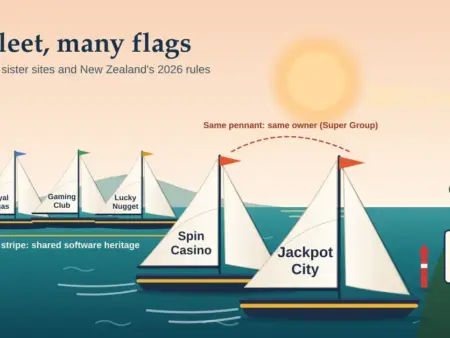
The network was built on the Microgaming platform, one of the oldest technology stacks in online gaming, which is why every connected brand shared a near-identical games library and interface. An important update, though: Microgaming sold its games portfolio and distribution business to Games Global in May 2022. The content most people still call “Microgaming games” — the Mega Moolah progressive network, long-running pokies and the familiar table games — is now distributed by Games Global, so references to “Microgaming” today describe heritage rather than the current content owner.On licensing, the network’s brands historically operated under offshore authorisations such as the Kahnawake Gaming Commission, with some content licensed for specific markets under other regulators. Under New Zealand’s 2026 framework, the relevant question is no longer which offshore regulator a site names but whether it holds a DIA licence; an offshore permit does not carry over automatically. Individual brand write-ups such as Cosmo Casino and Casino Classic go into the specific licence details for those members.Which brands shared the Casino Rewards loyalty account
A single Casino Rewards login covered a cluster of separately themed brands that all fed the same loyalty balance. Publicly named members have included Zodiac Casino, Yukon Gold Casino, Luxury Casino, Captain Cooks Casino, Grand Mondial Casino, Casino Classic and Golden Tiger Casino, among others. They differed mainly in theme, visual style and the shape of their welcome offers rather than in the underlying games or the loyalty engine.This is listed for reference and to explain how the shared account worked, not as a set of recommendations. Because these are offshore brands that closed to new New Zealand sign-ups in April 2026 and are not DIA-licensed, no sign-up links are provided. The practical relevance for Kiwi readers today is understanding that “different casino, same points” was the design, not a loophole.Common mistakes players made with casino loyalty programmes
The most expensive mistake was treating loyalty value as a reason to play more. Because points scale with wagering, chasing a higher tier or more sweepstakes entries almost always costs more in stake than it returns in perks. A loyalty scheme rewards activity you were going to do anyway; it does not make extra activity profitable.- Confusing VIP points with cash. Redeemed points became bonus credit with wagering conditions, not withdrawable money, so a large points balance was worth far less than its headline figure suggested.
- Mixing up the two currencies. VIP points (spendable) and status points (tier-defining) behaved differently, and assuming they were one and the same led to miscalculating both redemption value and tier progress.
- Assuming loyalty improved odds. Tiers never changed a game’s return-to-player or house edge, yet some players bet bigger believing status gave them an advantage.
- Relying on outdated guides. Thresholds, rates and — critically — the network’s availability to New Zealanders all changed in 2026, so older advice recommending sign-up is now simply wrong.
- Ignoring the licence question. An offshore permit is not a DIA licence, and from 1 December 2026 only DIA-licensed operators may lawfully serve New Zealand players.
Who the Casino Rewards loyalty programme suited
Historically, the programme suited players who wanted to spread low-stakes recreational play across several themed casinos without losing their accumulated status each time they switched brand. The pooled account rewarded that behaviour better than a cluster of standalone loyalty schemes would have. It appealed to fans of classic Microgaming-era pokies and the Mega Moolah jackpot network in particular.For New Zealand readers in 2026 the honest answer is different: because the network closed to new Kiwi registrations and the domestic legal framework has changed, the programme is now mainly of historical interest. Anyone researching current real-money play should focus on operators that will hold a New Zealand DIA licence and should set firm budget and time limits before playing at all. The practical value of this article is understanding the mechanics, not acting on them.The brand guides to Golden Tiger Casino, Vegas Palms, Quatro Casino, Villento Casino, Casino Kingdom, Luxury Casino and Yukon Gold Casino explain how the shared loyalty account worked at each site and where each brand stands for New Zealand players in 2026.
Responsible gambling and support in New Zealand
Online gambling is a form of paid entertainment that carries real financial risk, and no loyalty scheme, tier or bonus changes that. If gambling is affecting your finances, mood, relationships or sleep, free and confidential help is available in New Zealand at any hour. Setting deposit, loss and time limits before you play — and using the responsible gambling tools most platforms provide — is the most reliable way to keep play within a budget you can comfortably afford.The Gambling Helpline Aotearoa offers free, confidential support 24 hours a day on 0800 654 655, or by texting 8006. The Safer Gambling Aotearoa / Choice Not Chance campaign can also help arrange face-to-face support in your area, and the Problem Gambling Foundation of New Zealand provides free counselling on 0800 664 262. Only adults aged 18 and over may gamble in New Zealand.Disclaimer: This article is general information about how the Casino Rewards loyalty programme worked and the current New Zealand legal position. It is not gambling, legal, financial or tax advice, and it is not an encouragement to gamble or to sign up with any operator. Rules, availability and figures change; always verify the current position with official sources before acting.Sources
- Licentium — New Zealand Online Casino Gambling Act 2026 Enters Into Force, 1 May 2026
- GamingTechLaw — New Zealand Online Casino Licensing 2026: Requirements, Deadlines and How to Apply
- Barchart — Casino Rewards celebrates milestone birthday (25 years, member brands)
- Online-Casinos.ca — How to earn and redeem Casino Rewards VIP points
- Yogonet — Games Global completes acquisition of Microgaming’s iGaming portfolio and distribution business (May 2022)
- Gambling Helpline Aotearoa — free, confidential support (0800 654 655 / text 8006)
- Safer Gambling Aotearoa / Choice Not Chance